Building for the Long Term: Atlantica Properties and the Future of Affordable Housing
Atlanta’s rapid growth has intensified pressure on the city’s housing supply. Over the past decade, rents across the metropolitan area have climbed sharply, while wages for many working households have not kept pace. Today, more than half of renter households in Atlanta are considered cost-burdened, spending over 30 percent of their income on housing. In fast-changing corridors like West Midtown, naturally occurring affordable housing is increasingly vulnerable to rent escalation and displacement.
Against that backdrop, preserving existing housing has become just as critical as building new supply.
 For Darion Dunn, that urgency is personal.
“As a landlord, you get a front row seat to people’s lives,” Dunn says. “You see how quickly things can change for families. That perspective changes how you think about housing.”
What began as entrepreneurship evolved into something more intentional. Today, as co-founder of Atlantica Properties, Dunn leads with a simple principle: strong fundamentals first, mission embedded throughout.
That philosophy shaped the acquisition of 12th & James, a 214-unit community in northwest Atlanta.
Originally built in 2002 with federal Low-Income Housing Tax Credits, the property was part of a national wave of affordable housing developed with a commitment to long-term rent restrictions. But across the country, thousands of these properties have exited affordability early through the federal “qualified contract” provision — a loophole that has allowed more than 120,000 apartments nationwide to convert to market-rate housing as neighborhoods strengthen and rents rise.
Like many Housing Credit properties in appreciating markets, 12th & James transitioned to market-rate rents after its initial compliance period ended. Located in Atlanta’s rapidly growing West Midtown neighborhood, the community was marketed competitively as a well-performing, mid-priced apartment property with strong occupancy and the potential for higher rents.
Out of roughly 20 offers, Atlantica and its partners submitted the highest bid.
But unlike other suitors, their plan was not to maximize rents. It was to restore affordability.
The $43 million acquisition required both speed and sophistication. The transaction included a Freddie Mac loan sized at approximately 65 percent loan-to-value and assumed a 10-year hold. Reinvestment Fund participated as a preferred equity investor in the transaction, investing alongside the Community Foundation for Greater Atlanta and Atlanta Neighborhood Development Partnership (ANDP) as fellow preferred equity partners and Atlantica Properties, EQ Housing Advisors, and Partners for HOME as common equity partners.
For Dunn, access to flexible equity capital was essential.
“Debt is more transactional,” he explains. “Equity is relationship-based. When your partners understand both the business and the mission, it changes what’s possible.”
If ten years from now, residents are still there — still paying affordable rents, still aging in place — that’s success. If families can stay rooted in their community while the city grows around them, that’s what matters.
Darion Dunn, Co-Founder, Atlantica Properties
Through partnerships with EQ Housing Advisors and Partners for HOME, the team at Atlantica Properties structured a private enterprise agreement with the Atlanta Urban Development Corporation. In exchange for reserving 50 percent of the units at 80 percent of Area Median Income or below — including 20 percent at 50 percent AMI and 10 percent at 60 percent AMI — the property qualifies for a 25-year property tax exemption.
That structure fundamentally reshaped the business plan.
The tax exemption reduces operating pressure, allowing the ownership team to deepen affordability while maintaining long-term stability. Just as importantly, the affordability commitment is embedded through a ground lease structure, ensuring that rent restrictions remain in place for 25 years, even if management changes.
“For me, long-term affordability means it lives beyond our stewardship,” Dunn says. “If we sell in ten years, that affordability is still there. That’s legacy.”
West Midtown has experienced significant transformation in recent years, with new development reshaping the corridor and pushing rents upward. The broader Atlanta metropolitan area continues to grow faster than national averages, driving sustained housing demand. In that environment, properties like 12th & James can quickly become targets for rent increases.
At acquisition, the property was 94 percent occupied and in strong physical condition, with most units renovated between 2019 and 2024. Rather than pursuing an aggressive value-add strategy, the team at Atlantica Properties allocated a $1 million capital reserve to address remaining improvements and long-term maintenance needs. The focus was stability — not displacement.
The project also includes 43 permanent supportive housing units for individuals transitioning out of homelessness.
Through its partnership with Partners for HOME, the development secured wraparound services from Georgia Harm Reduction Coalition, providing specialized support for formerly unhoused residents.
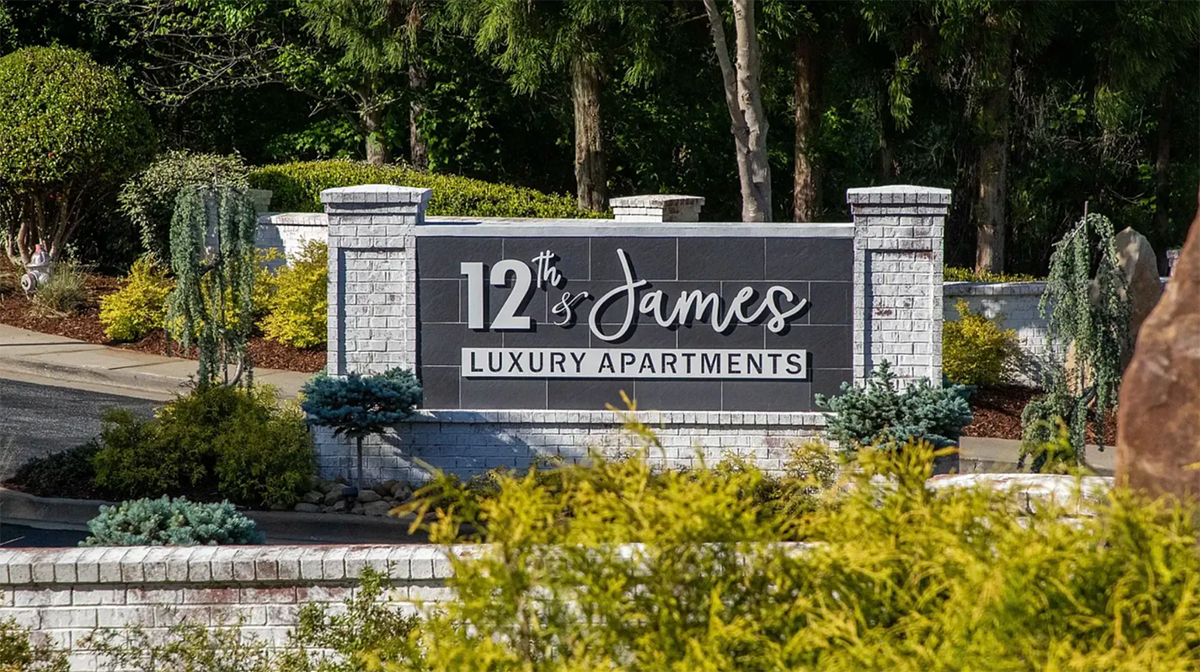
12th & James, a 214‑unit community in Atlanta’s West Midtown, where mission‑driven partners are preserving long‑term affordability and stability for local residents.
For Dunn, integrating supportive housing reflects a broader responsibility.
“We’re long-term landlords,” he says. “We’re not merchants. If we structure deals properly and build them on a strong foundation, we can create housing that’s both sustainable and meaningful for the community.”
For Reinvestment Fund, the opportunity represents more than a single transaction. It reflects a broader commitment to support community-rooted developers and preserve affordability in competitive markets. By committing equity rather than debt, Reinvestment Fund aligned directly with the property’s and the developer’s long-term success, sharing in both risk and opportunity.
The investment also aligns with Reinvestment Fund’s goals of supporting development firms seeking to scale their businesses while maintaining affordability commitments.
Atlantica Properties, founded in 2010 and led by brothers Darion and Trenton Dunn, has steadily grown from single-family acquisitions into larger multifamily and supportive housing developments. Following the completion of the 12th & James transaction in June 2025, Atlantica Properties acquired Lofts at Twenty25—a Buckhead high-rise featuring 623 units—for $90 million in December 2025.
Dunn emphasizes that impact and discipline are not opposing forces.
“We’re careful about the deals we pursue,” he says. “We want them to be strong financially so they can hold up over time. When the fundamentals are solid, that gives us the ability to deliver on the mission in a real and lasting way.”
Atlanta’s leadership has set ambitious goals to preserve and expand affordable housing as the city continues to evolve. Transactions like 12th & James demonstrate how competitive acquisitions can be leveraged to protect affordability rather than erode it.
For Dunn, the measure of success is simple.
“If ten years from now, residents are still there — still paying affordable rents, still aging in place — that’s success,” he says. “If families can stay rooted in their community while the city grows around them, that’s what matters.”
Through disciplined underwriting, public-private structuring, and mission-aligned equity, 12th & James demonstrates how financial rigor and long-term affordability can reinforce one another. In a rapidly changing housing market, that balance is essential — not just for 214 homes in northwest Atlanta, but for the future of equitable growth across the country.