Overview
- ECE Programs Grants and resources available for Early Childhood Education projects
- HBCU Brilliance Initiative Targeted financial support for Historically Black Colleges and Universities
- Food Systems Programs Food justice grants serving Philadelphia and the national HFFI program
- PA Coronavirus Small Business Assistance Program
- Social Determinants of Health Initiatives including national Invest Health and regional Building Healthier, More Equitable Communities in NJ
Meet the Team
Overview
- About our Financing Investing in projects that are both targeted and transformative
- Loan Products Financing for a variety of project needs
- Climate & Sustainability Financing for a broad variety of projects from solar to energy-efficient retrofits
- Small Scale Developers Financing that supports small scale housing developers
- New Markets Tax Credit (NMTC) Leveraging private-sector equity and loan capital investment
- Pay for Success Aligning public investment and high impact services
MEET THE TEAM
OVERVIEW
- What we do & how we work A commitment to build strong, healthy, more equitable communities
- Where we work National reach with offices in Atlanta, Baltimore, and Philadelphia
- Mission & Values What guides us as an organization
- Background Our founding, history and our industry
- Work with us Current career opportunities
- Governance Meet our Board of Directors
Meet the Team
OVERVIEW
- Policy Solutions Supporting data-driven, strategic decision-making and investment to strengthen communities
- Market Value Analysis An analytic tool to guide neighborhood revitalization and equitable development strategies
- Limited Supermarket Analysis A tool to understand and address inequitable access to fresh and healthy food
- Housing Research and Analysis Quantitative and qualitative analyses on topics such as fair housing and eviction and foreclosure prevention
- Early Childhood Education Analytics Data-driven approaches to reducing gaps in access to high quality early learning
Guaranteed Resources Optimize Wellbeing: Evaluating a Cash Transfer Program in Philadelphia
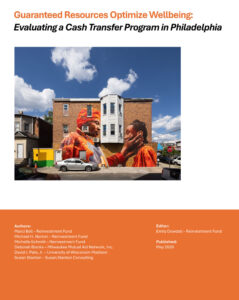 Cash transfer programs, also known as guaranteed or basic income programs, provide unrestricted cash payments to recipients, in contrast to public assistance programs like SNAP and Housing Choice Vouchers that cover specific expenses. The potential of cash transfer programs to improve the lives of recipients has garnered increasing attention from policymakers and researchers.
Reinvestment Fund joined with researchers David J. Pate, Jr., Deborah Blanks, and Susan Stanton to evaluate a cash transfer program pilot in Philadelphia: the Guaranteed Resources Optimize Wellbeing (GROW) study. We found that:
- Treatment participants experienced modest yet significant improvements in financial wellbeing, in social and psychological wellbeing, and food security.
- Qualitative analysis illuminated three key benefits of the GROW program: substantial investments in children, reduction in food insecurity, and an increased focus on personal and family wellbeing by parents.
- Reductions in financial stress created space for participants to focus on other aspects of their lives such as parenting, education (their children’s and their own), their jobs and careers, and their futures.
- Participants expressed increased feelings of confidence, self-efficacy, and optimism during the pilot period.
- Participants highlighted the reliability and flexibility of the payments, whether $500 or $50, as important sources of stability in their lives.
- Though observed improvements among Treatment group participants returned to baseline or slightly worse immediately after the monthly payments stopped at the end of the study (and economic shock effect), interviewees still expressed gratitude for the experience.
We conclude with these recommendations:
- Increase the monthly amount in cash transfer programs like TANF (which haven’t been adjusted since the 1990s) and tie payments to inflation to ensure benefits keep pace with the cost of living.
- Taper cash transfer payments over time to mitigate the benefits cliff/economic shock effect.
- Offer bridge funds for those transitioning out of the program due to employment or increases in income.
- Provide unrestricted cash supplements for TANF and E-TANF families during waits for mental health and other health services (up to six months).
- Expand access to mental health services to promote holistic wellbeing.
About the Authors
Marci Bell
Policy Analyst IIMarci Bell is a Policy Analyst II on the Policy Solutions team. In this role, she leverages SQL, R, and ArcGIS to conduct rigorous spatial, statistical, and qualitative analyses. Mrs. Bell collaborates with a range of clients—including nonprofit organizations, private foundations, and city governments—to inform evidence-based policy recommendations, support programmatic improvements, and deliver technical assistance.
Michelle Schmitt
Senior Policy AnalystMichelle Schmitt uses quantitative and qualitative analysis to help clients assess their impact, evaluate their programming, and clarify their policy goals for Reinvestment Fund. She is currently working on a national study supported by the Institute of Museum and Library Services to understand the different ways museums and libraries contribute to the quality of life in their local communities, in addition to working on an analysis of minority homeownership in Pennsylvania, and a Market Value Analysis of St. Louis, Missouri.
Emily Dowdall
President, Policy SolutionsEmily Dowdall is President of Policy Solutions at Reinvestment Fund. She works with government, philanthropic, nonprofit, and other civic leaders across the country to support strategic decision-making to strengthen communities. Ms. Dowdall leads a team of skilled analysts in conducting research and building analytic tools that help stakeholders implement effective interventions and address entrenched challenges. Her expertise includes approaches to understanding and intervening in housing markets, strategies to stabilize households and neighborhoods, affordable housing needs, fair housing, early child education access, and program evaluation.
Latest Insights
By using this website, you agree to our Privacy Policy and you consent to our placement of cookies on your device. X
Manage consent
Privacy Overview
This website uses cookies to improve your experience while you navigate through the website. Out of these, the cookies that are categorized as necessary are stored on your browser as they are essential for the working of basic functionalities of the website. We also use third-party cookies that help us analyze and understand how you use this website. These cookies will be stored in your browser only with your consent. You also have the option to opt-out of these cookies. But opting out of some of these cookies may affect your browsing experience.
Necessary cookies are absolutely essential for the website to function properly. These cookies ensure basic functionalities and security features of the website, anonymously.
| Cookie | Duration | Description |
|---|---|---|
| cookielawinfo-checkbox-analytics | 11 months | This cookie is set by GDPR Cookie Consent plugin. The cookie is used to store the user consent for the cookies in the category "Analytics". |
| cookielawinfo-checkbox-functional | 11 months | The cookie is set by GDPR cookie consent to record the user consent for the cookies in the category "Functional". |
| cookielawinfo-checkbox-necessary | 11 months | This cookie is set by GDPR Cookie Consent plugin. The cookies is used to store the user consent for the cookies in the category "Necessary". |
| cookielawinfo-checkbox-others | 11 months | This cookie is set by GDPR Cookie Consent plugin. The cookie is used to store the user consent for the cookies in the category "Other. |
| cookielawinfo-checkbox-performance | 11 months | This cookie is set by GDPR Cookie Consent plugin. The cookie is used to store the user consent for the cookies in the category "Performance". |
| viewed_cookie_policy | 11 months | The cookie is set by the GDPR Cookie Consent plugin and is used to store whether or not user has consented to the use of cookies. It does not store any personal data. |
Functional cookies help to perform certain functionalities like sharing the content of the website on social media platforms, collect feedbacks, and other third-party features.
Performance cookies are used to understand and analyze the key performance indexes of the website which helps in delivering a better user experience for the visitors.
Analytical cookies are used to understand how visitors interact with the website. These cookies help provide information on metrics the number of visitors, bounce rate, traffic source, etc.
Advertisement cookies are used to provide visitors with relevant ads and marketing campaigns. These cookies track visitors across websites and collect information to provide customized ads.
Other uncategorized cookies are those that are being analyzed and have not been classified into a category as yet.