Built on Three Generations, Clara's Little Lambs Invests in the Next One
In 1986, Clara Washington worked days at a Sears department store in Gretna, Louisiana, about 10 minutes from a childcare center she had just opened in Algiers, a New Orleans neighborhood on the west bank of the Mississippi.
On her breaks, she handed out cards advertising a childcare center she had just opened nearby. Parents who had never seen the building enrolled their children anyway, on the strength and the passion of Washington herself.
Forty years later, that business is opening a fourth location. Clara’s Little Lambs Preschool Academy is now led by Washington’s daughter, Sonjia Joseph, who has co-run the school alongside her mother since it first opened its doors. Joseph raised her own daughters at the school, keeping a crib in her office.
“It really makes me proud to know that I have three generations here pouring into our mission,” Joseph said. Families feel that continuity too. One child now enrolled is the granddaughter of a woman Joseph graduated high school with, and whose own daughter also came through the program.
That history is not sentiment. It is capacity families count on, and it is running short.
Families Far From Home
Across its three existing sites, Clara’s Little Lambs carries a waitlist of 397 children, many of them military families transferred to Federal City—a Base Realignment and Closure site with an active Marine Corps Support Facility and U.S. Coast Guard Sector—with no grandparents or local support nearby.
“I’ve had the colonel of the school call me and say, I need you to take this teacher’s kid because he can’t come to work unless this child has care,” Joseph said.
The census tract where the new center will sit qualifies as severely distressed under New Markets Tax Credits (NMTC) guidelines, with a poverty rate of 20.6 percent and unemployment running roughly one and a half times the national average. A market study found a gap of nearly 10,400 early childhood seats across the surrounding service area.
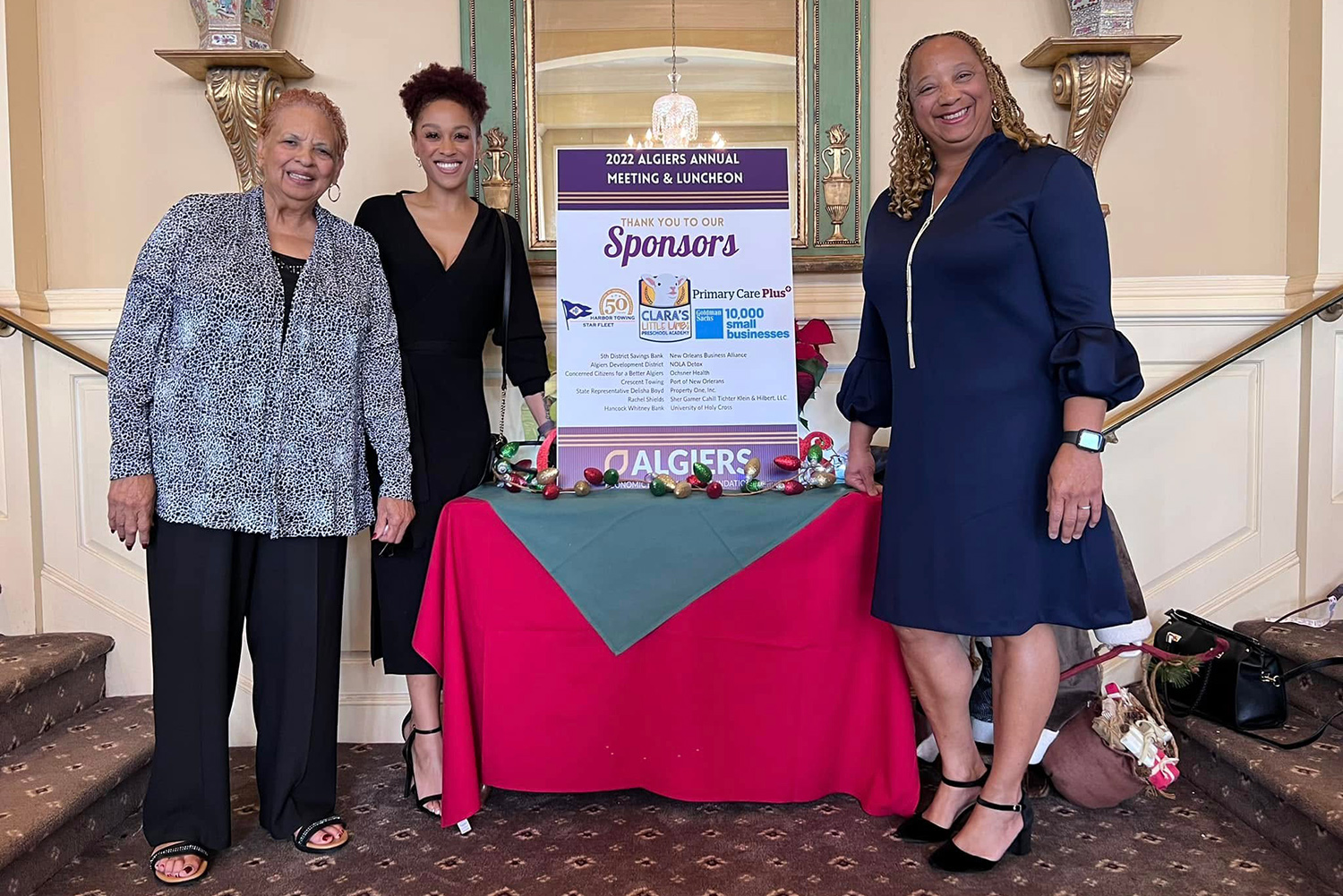
At the 2022 Algiers annual meeting and luncheon.

The front entrace of Clara’s Little Lambs Pre-School Academy of Federal City.

Two kids at Clara’s Little Lambs.
“This is an economic issue,” Joseph said. “Companies in Louisiana lose billions of dollars in revenue because people cannot come to work when they do not have high-quality, affordable childcare. We really are the backbone of an economy in a community, whether you have kids or not.”
That need is what drew the Algiers Development District, the quasi-governmental agency that led the Federal City BRAC conversion and is ground lessor, to Joseph directly.
After early conversations about purchasing the land fell through on price, the district offered Clara’s Little Lambs a fifty-nine-year lease for 100 dollars a month. “It was an offer too good to be true that I could not pass up,” Joseph said. “That’s how committed they were to having us on site.”
Financing the new, 13,000-square-foot center meant something Joseph and her mother had spent 40 years avoiding: debt. “We have never had debt,” Joseph said. “We always prided ourselves on making sure our bills were taken care of, because childcare can be so fluid.”
Taking on financing for a $12.9 million building was one of the harder decisions of her career, she said, but she credits Alembic Community Development, working as her development partner, and Reinvestment Fund, which joined the capital stack as a lender and NMTC allocatee. “Having people take the time to explain the process and having enough trust in Alembic and Reinvestment Fund to take this on, was a big deal for us,” she said.
The project is financed by a $10.5 million federal NMTC allocation from Reinvestment Fund, alongside $10 million in Louisiana state NMTCs allocated by Gulf Coast Housing Partnership. U.S. Bank Impact Finance invested in both credit tranches. Reinvestment Fund also provided a $3.5 million source loan and joined the capital stack as a lender, while Alembic served as owner’s representative, NMTC consultant, and construction completion guarantor.
Need Matches Speed
For Jonathan Leit, principal at Alembic, the project stood out for how quickly it moved.
Alembic’s typical predevelopment timeline runs eighteen months at minimum, often two to three years. Though Sonjia and Jonathan knew one another previously, the project truly first began with an intentional partnership in fall 2025 and closed in August 2026, compressed by a hard deadline on the state’s tax credit allocation. “This was by far the fastest we have ever started and then closed a project,” Leit said.
Speed did not change what Alembic looks for in a financing partner. “We were diligent in finding the right partner,” Leit said. “We needed people who understand early childhood centers, and Reinvestment Fund very much does with their experience,” citing the organization’s history in early childhood education as one of the deciding factors.
Underwriting on a compressed timeline still strengthened the project rather than just financing it, he said. “Reinvestment Fund approaches underwriting as a useful exercise to improve the operations and the outcome, not as a hurdle.”
Leit also said the project gave Alembic a chance to do something rare with early childhood providers: design a building around the operator’s own needs, rather than retrofitting a space built for something else. “It is so rare for a provider to get to design their own space, purpose-built for them,” he said. “Too often, providers have to make do in spaces designed for something else. We saw this as a chance to give Clara’s Little Lambs, its teachers, and its families what they deserve.”
An Anchor for Federal City
Joseph is already picturing what the finished building will do for the surrounding neighborhood.
Federal City has spent years planning new housing and mixed-use development around the former naval base, and she expects the childcare center to help pull that plan forward. “A strong early childhood center in a community really becomes the anchor,” she said. “I think it will help speed that process and attract developers who say, there is an infrastructure here already: a strong high school, an elementary school across the street, and now this childcare facility.”
Joseph measures success in 5 years less by enrollment numbers than by the children who move through the building: infants who grow into confident preschoolers ready for kindergarten, with the language and social skills to succeed once they get there.
“It will look like families who are able to go to work and stabilize because they finally have reliable, high-quality childcare they can count on,” she said. For a business that has spent 40 years building trust one family at a time, now working for the first time in a space designed around its own vision of what childcare should be, that is the point the whole project was built to reach.