Health, Education, and the Arts: The South Bronx Builds a Once-in-a-Generation Opportunity
In the Mott Haven-Port Morris neighborhood of the South Bronx, a three-story building that has sat empty for 15 years finally has new life under community leadership.
During more than ten years of organizing and visioning, the community has known it simply as the HEArts Center, named for the health, education, and arts programming that will return to a property that has already meant more to this neighborhood than most ever do.
A South Bronx Building With a History of Community Care
Built in 1931 as a Public Works Administration project, it opened as the Mott Haven Health Center, later known as the Lincoln Recovery Center.
In 1970, at the height of a heroin epidemic that disproportionately ravaged low-income communities like the South Bronx, the Young Lords, the Black Panthers, and allied health workers took a stand and established the Lincoln Detox Collective, known in the neighborhood as the People’s Detox Center. The Collective popularized the use of the five-point ear acupuncture protocol for addiction treatment, and paired it with political education and peer support, operating the program until 1978, when political pressures pushed them out.
The building and subsequent health services then closed permanently in 2011, leaving it vacant on a block in one of the most densely populated, most industrially burdened corners of New York City.
A Decade of Community Organizing and Visioning
Mychal Johnson lives on that block. He brought his own mother there for acupuncture before the closure, then watched it sit empty for more than a decade.
Johnson is a cofounder of South Bronx Unite, formed in 2012 after he and his neighbors opposed a $130 million subsidy package for a food distribution company moving into their neighborhood. The legal challenge did not succeed, but the organizing did not stop. “I’ve been an organizer with other local residents, identifying ways to promote self-determination and to enhance education, health, and arts and culture in our community,” Johnson said. When the health center went vacant, that same group of neighbors set out to determine what it could become.
Mott Haven-Port Morris is home to roughly 60,000 people in two and a half square miles and carries a disproportionate share of the city’s power plants and diesel truck traffic. One in four children have asthma, and the census tract is designated deep distress, with a poverty rate above 41 percent and an unemployment rate nearly double the national average.
“We saw this building as an opportunity to increase educational outcomes, occupational outcomes, and health outcomes, and use arts and culture as a way of connecting those together,” Johnson said.
That is the case he and his neighbors built the vision on. Johnson organized a feasibility team of architects and consultants and, working with the city council member who was then speaker of the New York City Council, secured access to the vacant building. Community visioning sessions held with architect Nandini Bagchee produced those three pillars in 2016, health, education, and the arts, and the name (HEArts Center) that has carried the project ever since. “We came up with that name together, not myself. I’ll take no credit for it. That’s something we came to as a community,” Johnson said.
We are 50-50 partners now, but we hope one day South Bronx Unite will be able to fully own the property as they should.
Jonathan Leit, Principal, Alembic Community Development
Finding a Development Partner for the HEArts Center
Turning that community-driven vision into a fully funded real estate project required a partner with deep expertise in complex community facility financing and New Markets Tax Credit experience. Johnson’s team found that partner in Alembic Community Development, which joined the Mott Haven-Port Morris Community Land Stewards, a land trust Johnson helped found in 2015.
Alembic is a mission-driven real estate development company that partners with nonprofits to build affordable and supportive housing and community facilities. It has brought investors and lenders together over years of complex redevelopment financing.
“We care deeply about all our projects, and the HEArts Center is particularly special,” remembers Jonathan Leit, Principal at Alembic Community Development. “When we met the Land Stewards, they were already close to a decade into community organizing, planning, and visioning. The ability for a community developer like us to come in and partner with an organization that has truly done the work in community, whose board and staff are all community members, was a privilege to execute on their vision.”
Alembic entered the deal as a 50-50 joint venture owner alongside the Mott Haven-Port Morris Community Land Stewards, structuring the project with the long-term goal of transferring full ownership to the community. “It’s equally about influence, control, decision-making, and shaping what this building is going to come back as,” Leit emphasized. “We are 50-50 partners now, but we hope one day they will be able to fully own the property as they should.”
Johnson and his neighbors brought relationships of their own, cultivated with elected officials over the same period. “They had the experience with New Markets and Historic Tax Credits and relationships with a lot of the funders and investors. That, coupled with our relationships, really made this work well,” Johnson said.
Financing the HEArts Center with New Markets Tax Credits
The more than $40 million project draws on $25 million in city and state grants and an estimated $9 million in state and federal Historic Tax Credit equity, layered with $35 million in New Markets Tax Credit allocation from a consortium: Reinvestment Fund ($10 million), Enterprise Community Partners ($10 million), Empire State New Market Corporation ($12 million), and U.S. Bank ($3 million). Together, that allocation generated about $10.5 million in NMTC equity for the project.
Reinvestment Fund also served as lead lender on a $30 million bridge loan secured by those public grants and historic tax credit equity, holding $16.5 million on its own balance sheet and selling $7.5 million and $6 million participations to Enterprise Community Loan Fund and BlueHub Capital, respectively.
Earlier still, in 2024, Reinvestment Fund extended a $1.05 million predevelopment loan that, along with an equal loan from the Leviticus Fund, kept the project moving while the permanent funding came together.
“Reinvestment Fund operated as an investor with New Markets, and as predevelopment financing before that. More so than probably any other investor or funder on this project, you all were extremely integral in moving us forward,” Johnson said.
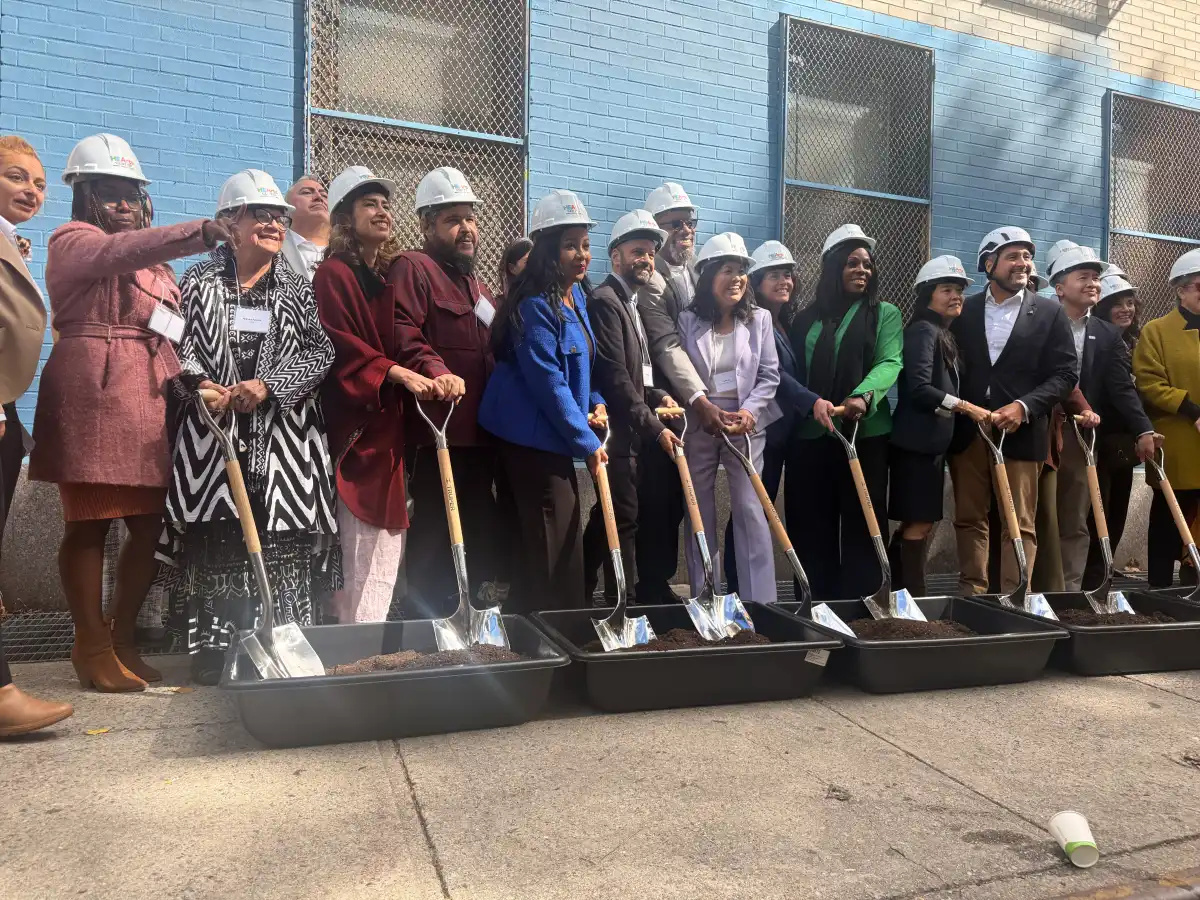
Partners and neighbors break ground on the HEArts Center in Mott Haven-Port Morris.
The deal carries the discipline of grant and tax-credit financing requirements. The three anchor tenants signed leases before closing, giving underwriters confidence in stable occupancy while keeping rents affordable. Reinvestment Fund will also serve as the construction disbursement agent, releasing funds against completed milestones under a bonded, stipulated sum contract.
Once the bridge loan is repaid, the building will carry no permanent debt beyond the New Markets financing, so rent only has to cover operating costs and modest financing costs rather than a traditional mortgage.
Why New Markets Tax Credits Mattered
Johnson is direct about what the tax credits made possible. “Without New Markets, the deal would not have happened in the same way it did. It was definitely a force that helped push the deal through,” he said.
Asked what he would tell policymakers deciding the program’s future, his answer returned to the idea that has anchored his organizing for more than a decade: invest in projects envisioned by the community, because that collaboration produces lasting change. “That collaboration creates generational change and opportunities,” he said.
With a 99-year ground lease from NYC Health + Hospitals, HEArts Center is built for the long term. “That’s a lifetime for many, more than my lifetime. It’ll be multiple generations of change,” Johnson said.
Health, Education, and the Arts Under One Roof
The building will house Green City Force, whose AmeriCorps program trains young adults from public and low-income housing for careers in sustainability, alongside UpBeat NYC, which has offered free music instruction to South Bronx children for more than a decade. The Land Stewards will operate a wellness hub on the third floor offering health screenings and holistic services at low or no cost. Organizers still host regular HEArts Before HEArts events to update neighbors, provide wellness services and celebrate community.
Johnson sees the ripple reaching beyond the building itself. “It shows our partners across the Bronx and across the city what is possible for them to try to create in their communities too. I think we’re serving as a really great example of self-determination and self-reliance,” he said.
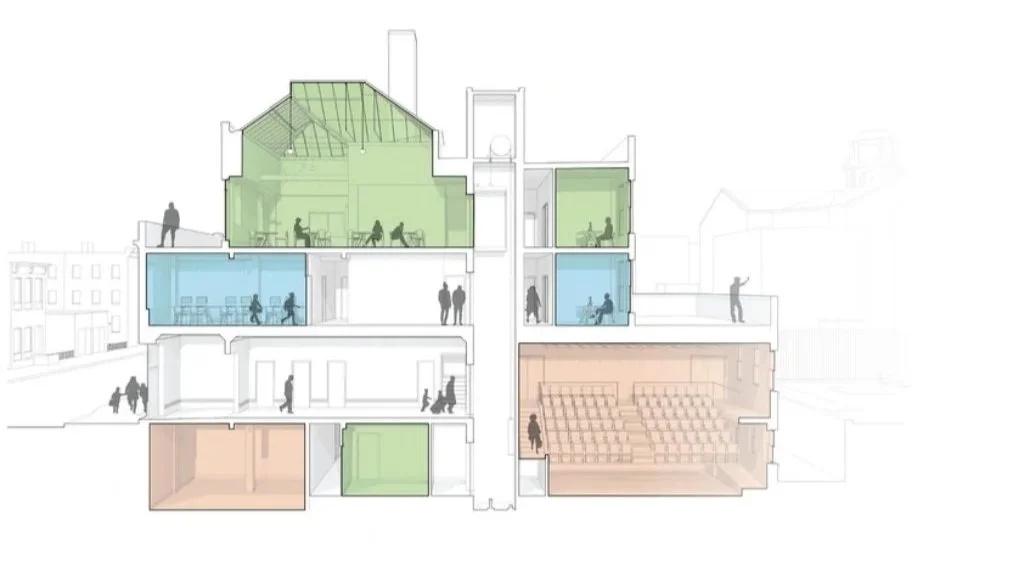
Architectural section drawing of the three-story HEArts Center.
A Relationship, Not a Transaction
Asked what advice he would offer another organizer or developer on a similar path, Johnson said, “When working with community, don’t make it transactional. Make it a relationship that’s mutual, not hierarchical, and something beautiful will happen.”
On the same South Bronx block Johnson has called home for more than twenty years, that kind of relationship is what turned a vacant health center into the HEArts Center, and what brought Reinvestment Fund, Alembic Community Development, the Land Stewards, and a consortium of city, state, and private partners to the table to help build it.